





Martial Arts for People Who Don't Think They're Athletic
Have you ever thought about trying a martial art, but immediately talked yourself out of it because you don't feel flexible, fit, or coordinated?
Do you worry that stepping into a dojo means keeping up with elite athletes or attempting impossible physical feats on day one?
If so, you are far from alone—and you might be surprised to learn that lack of athletic experience is actually the best place to start.
In this article, we’ll debunk the common myth of the "natural athlete" in martial arts, explain how traditional Karate builds strength, balance, and endurance from the ground up, and walk you through what to expect during your very first class.
The Myth of the "Natural Athlete"
When people picture a martial artist, they often visualize Hollywood action stars performing high-flying kicks and impossible acrobatics. This depiction causes many beginners—especially adults—to talk themselves out of trying a class before they ever begin.
In reality, traditional Karate was never designed solely for natural athletes. It was created as a practical system of self-defense, body awareness, and personal growth accessible to people of all ages, sizes, and backgrounds.
Martial arts do not require you to arrive with existing athletic traits:
- Flexibility is built over time: You do not need to do the splits to kick effectively. Beginners start with low, controlled strikes that respect their current range of motion.
- Stamina develops gradually: A good class scales intensity to match your current endurance. Nobody expects a beginner to keep pace with an experienced student.
- Coordination is learned, not inherited: Karate breaks complex body movements down into simple, repeatable patterns called kata (forms) and step-by-step drills.
How Karate Builds Fitness from the Ground Up
Instead of requiring fitness as a prerequisite, Karate serves as the engine that creates fitness. Training is fundamentally about efficiency—learning how to generate speed, power, and stability through correct posture and technique rather than raw brute strength.
1. Progressive Technical Skill
In a structured Karate program, instruction begins with foundational stances and basic strikes. As your muscles adapt and your neuromuscular connections strengthen, your movement becomes smoother and more efficient naturally.
2. Functional Core and Balance
Karate techniques rely heavily on your center of gravity. Simple training drills naturally build core strength, balance, and spatial awareness—benefiting your everyday movement off the mat as well.
3. Individual Progression
Unlike team sports where performance depends on keeping up with the fastest player, martial arts is an individual journey. You progress at your own pace alongside supportive instructors and training partners.
What to Expect in Your First Karate Class at JMAC
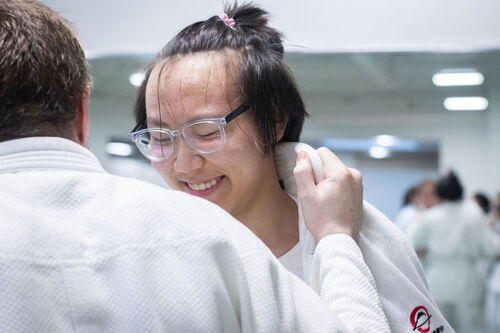
Stepping into a dojo for the first time can feel intimidating, but our beginner-friendly environment at the Japanese Martial Arts Center is designed to make the transition seamless and welcoming.
- Warm-Up: Gentle joint mobility exercises and dynamic stretching to prep your body safely.
- Basic Technique (Kihon): Learning fundamental blocks, punches, and kicks in a controlled setting.
- Forms (Kata): Practicing structured movement patterns that improve balance and body control.
- Light Application: Controlled partner drills focusing on distance, timing, and defensive positioning.
Our instructors focus on meeting you right where you are, ensuring that every technique is scaled to your comfort level and physical goals.
Start Your Journey with Karate in Ann Arbor
You don't need to "get in shape" before starting martial arts—getting in shape is what training is for. The only actual prerequisite for learning Karate is a willingness to show up, stay patient with yourself, and enjoy the process.
If you are ready to see how traditional training in Karate in Ann Arbor can improve your confidence, focus, and physical well-being, come visit us at the Japanese Martial Arts Center on Boardwalk Drive in Ann Arbor. Drop by a class or reach out to schedule your first introductory session today!